How to build a reading habit
Updated 19 August 2026
Short answer
Pick a moment that already happens every night — getting into bed is the strongest one — and make the ordinary version ten pages or fifteen minutes. Then set a hard-day version of one page, and mean it.
The one page is the part that decides whether this works. Reading is the habit most often abandoned over a target, because the target is set in the afternoon by someone imagining how alert they will be at eleven at night.
- Getting into bed is the best cue most people have for reading: it happens nightly and it puts you in the right place.
- One page is a real night's reading, not a failed one.
- Reading is a substitution, not an addition. The time comes from the phone or it does not exist.
- Keep the book where the cue leaves you. A book in another room is a decision.
- Page targets and yearly book counts are the most common reason people stop.
- If you fall asleep after a paragraph, the habit worked. Sleep is not the failure condition.
Why reading in particular stops
Most habits are added to a day. Reading is different: the twenty minutes has to come from somewhere, and in almost every case the somewhere is a phone. That makes reading a swap rather than an addition, and it is why advice about "finding time" does nothing — practising a language is a swap of exactly the same kind. The time is already spent.
The second thing that is specific to reading is that it is done at the tiredest point of the day, by a person who agreed to it while fresh. Ten pages is a small ask at four in the afternoon and a large one at half past eleven. Anything that requires a decision at that hour loses.
Third, reading is unusually infected with targets. Book counts, page counts, a shelf to finish by December. A target makes a short night into a shortfall, and a run of short nights into a reason to stop.
The plan
The moment. Getting into bed is the strongest cue available for most people: it happens every night, it has a clear edge, and it leaves you exactly where the reading happens. If your evenings are unreliable, two others work well — after you finish dinner, or sitting down with a morning coffee. Morning reading is underrated precisely because you are not tired.
The ordinary version. Ten pages, or fifteen minutes, or one chapter. Any of the three. Chapters are the least reliable because their length is not yours to choose.
The hard-day version. One page. On the worst nights, one paragraph, or opening the book and reading a line. This is not a consolation prize. The association being built is bed, then book, and one page builds it exactly as well as thirty do.
Where the book lives. On the pillow, or on the bedside table, open and face down. A book on a shelf in another room turns the cue into an errand, and the errand is where it dies.
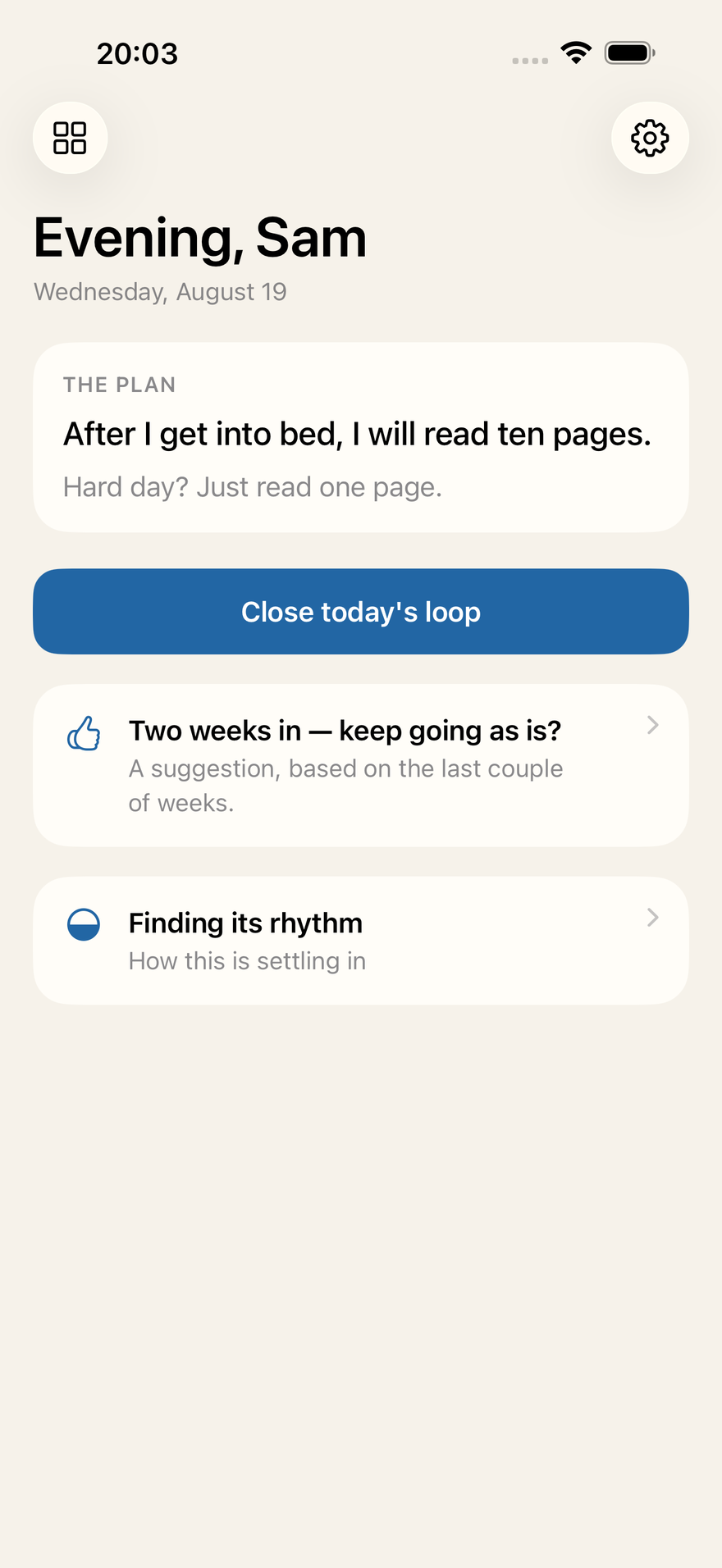
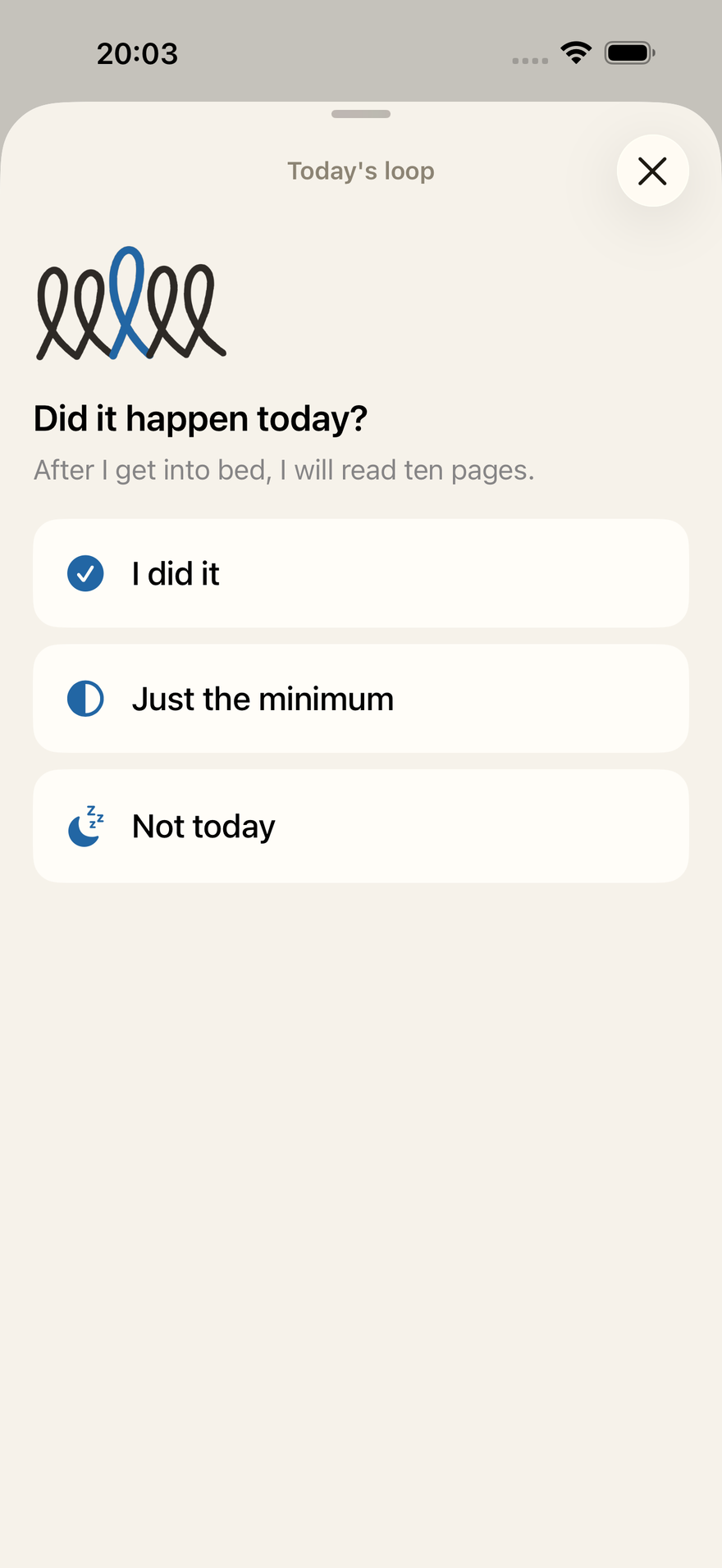
Mini Loops holds the moment, the ordinary version and the one-page version as one plan, and asks about it once a day. See it on the App Store
The phone question
If the phone is in the bed, the book loses. This is not a matter of willpower and it is not worth treating as one: one of the two objects is engineered to hold attention and the other is not.
The version that works for most people is not a rule about the phone but a change of place — leaving it charging in the hall, or across the room. If that is itself the thing you cannot manage, it is a habit of its own and worth building first, on its own, before reading is attached to it. Two new habits chained together fail together.
If it stops happening
Read the reason rather than the count. Three patterns cover nearly all of it:
- "Too tired" repeatedly. The size is wrong for the hour. Halve it, or move the whole habit to the morning.
- "Forgot" repeatedly. The book is not where the cue leaves you. Move the book, not your intentions.
- "Didn't want to" repeatedly. Usually the book. A book you are finishing out of duty is the most common invisible cause of a stalled reading habit, and abandoning it is a legitimate move. Nothing is owed to a book either.
What is not a useful response is adding pages tomorrow to make up for tonight. There is no debt. See what to do when you miss a day.
How Mini Loops handles it
Setup offers reading as one of its ready-made habits, with the three moments above, the three ordinary sizes and the three hard-day versions already written, so the plan is four taps rather than four blank fields. After that it asks two questions a night and takes about ten seconds.
There is no page count, no book total and no streak. If "too tired" comes up repeatedly it says so and proposes a smaller version or a different moment, and you accept or decline it.
Common questions
How do I build a reading habit?
Attach it to a moment that already happens daily — getting into bed is the strongest for most people — set an ordinary version of about ten pages, and set a one-page version for hard nights. Keep the book where the cue leaves you. Do not set a book or page target.
How many pages should I read a day to build the habit?
For building the habit, one page is enough, because repetition in a consistent context is the mechanism and page count is not part of it. Ten pages is a reasonable ordinary version. What matters is that the floor is low enough that no night can stop it.
Is it better to read in the morning or at night?
Night is the more common cue and the easier one to attach to, since getting into bed happens every day. Morning is often the more reliable one, because you are not tired and nothing has gone wrong yet. If evenings keep failing, moving to morning is usually a better fix than trying harder at night.
Why do I keep giving up on reading?
Usually one of three things: the nightly target was set by a version of you who was not tired, the book is somewhere the cue does not take you, or you are persevering with a book you are not enjoying. All three are faults in the plan rather than in you.
Does audiobook listening count as a reading habit?
For habit-building purposes it is a different habit, because the cue and the context are different — usually a commute or a walk rather than a chair. It is a perfectly good habit. It just is not the one you are building if the plan says bed.
What if I fall asleep after one page?
Then the habit happened. The repetition was the point, and falling asleep afterwards is not a failure condition. This is the most common worry about bedtime reading and the least important.