How to drink more water every day
Updated 19 August 2026
Short answer
Attach one glass to something that already happens: pouring your first coffee, sitting down at your desk, or brushing your teeth. The hard-day version is three sips.
Water is unusual among habits in having no natural moment at all. Everything else here attaches to an event; drinking water is imagined as happening “throughout the day”, which is not a cue and produces no repetitions.
- “Throughout the day” is the problem, not the solution. Pick one event and attach one glass to it.
- Three sips at the right moment builds the habit. A litre at six in the evening does not.
- A bottle left where you will see it is environment design, and it does more here than in any other habit.
- Daily totals are unmeasurable without effort, which is why they get abandoned.
- Once one glass is automatic, adding a second moment is easier than raising the first.
- This page is about the habit, not about how much you should drink. That is a question for a doctor.
Why this one is different
Almost every habit problem is a size problem. This one is a cue problem, and it is worth being clear about the difference, because the usual advice does not apply.
Drinking a glass of water is already trivially small. Nobody fails at it because it is too hard. They fail because nothing in the day says now. A habit is a learned link between a situation and a response, and if the situation is "sometime", there is nothing for the response to attach to. You get no repetitions, so nothing is learned, so it stays a thing you have to remember, forever.
This is also why water is the habit most often "solved" with a bottle. The bottle works, and it is worth using, but it is doing something different from what a habit does: it is changing what is in front of you rather than what you do automatically. Both are legitimate. Only one of them survives being away from your desk.
The plan
The moment. Pick something that happens daily, has a hard edge, and takes place near a tap or a kettle. Three that work well: pouring your first coffee, sitting down at your desk, and brushing your teeth. The coffee one is the strongest for most people because it is already a small ritual with an unavoidable pause in it while something brews.
The ordinary version. One full glass. Two if you want. Filling and finishing a bottle if that is your setup.
The hard-day version. Three sips. This looks absurd written down and it is the reason the habit survives a day of back-to-back meetings.
The bottle. Full, and where you will see it — the same trick that works for vitamins and against vegetables you never prepared. Not in a bag. Environment does more of the work here than in any other habit on this site, so it is worth spending the thirty seconds.
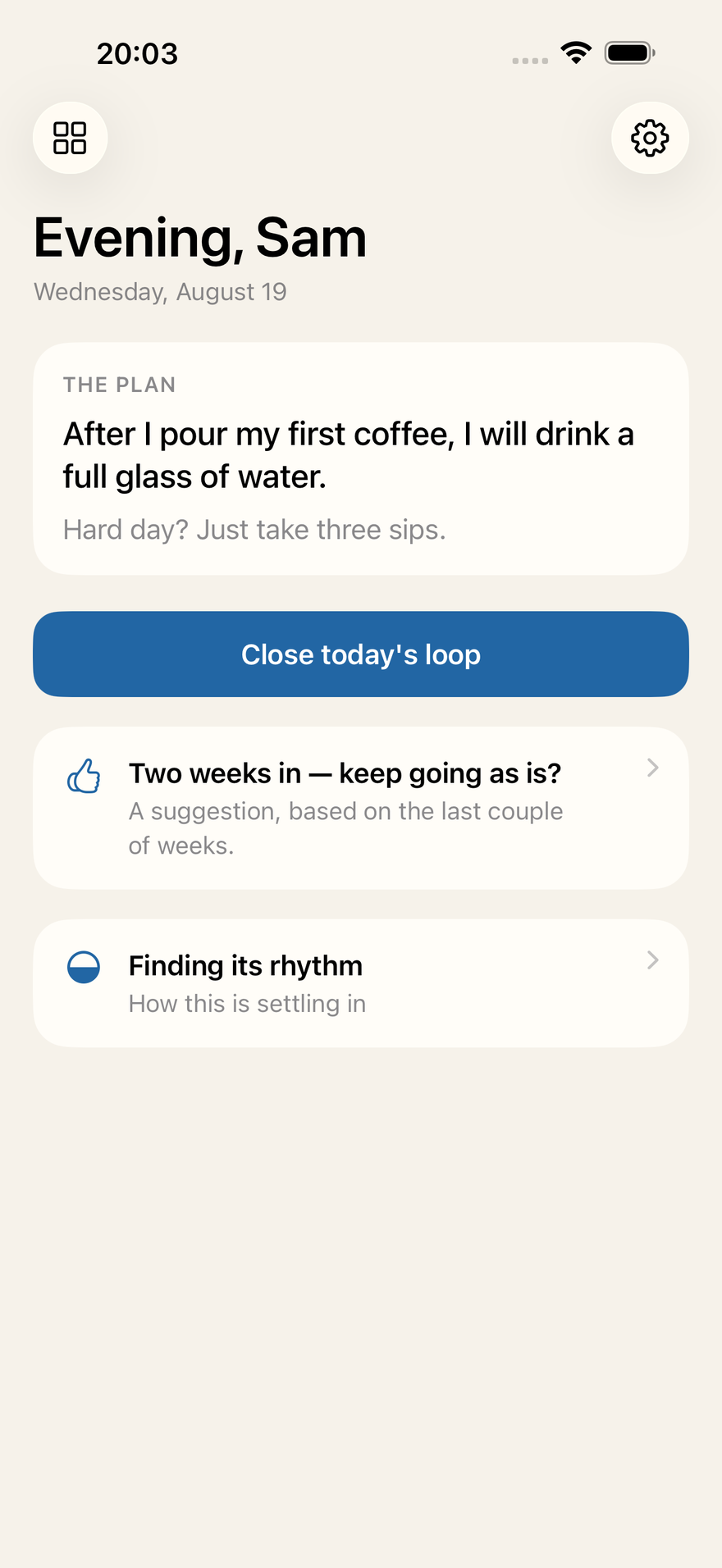
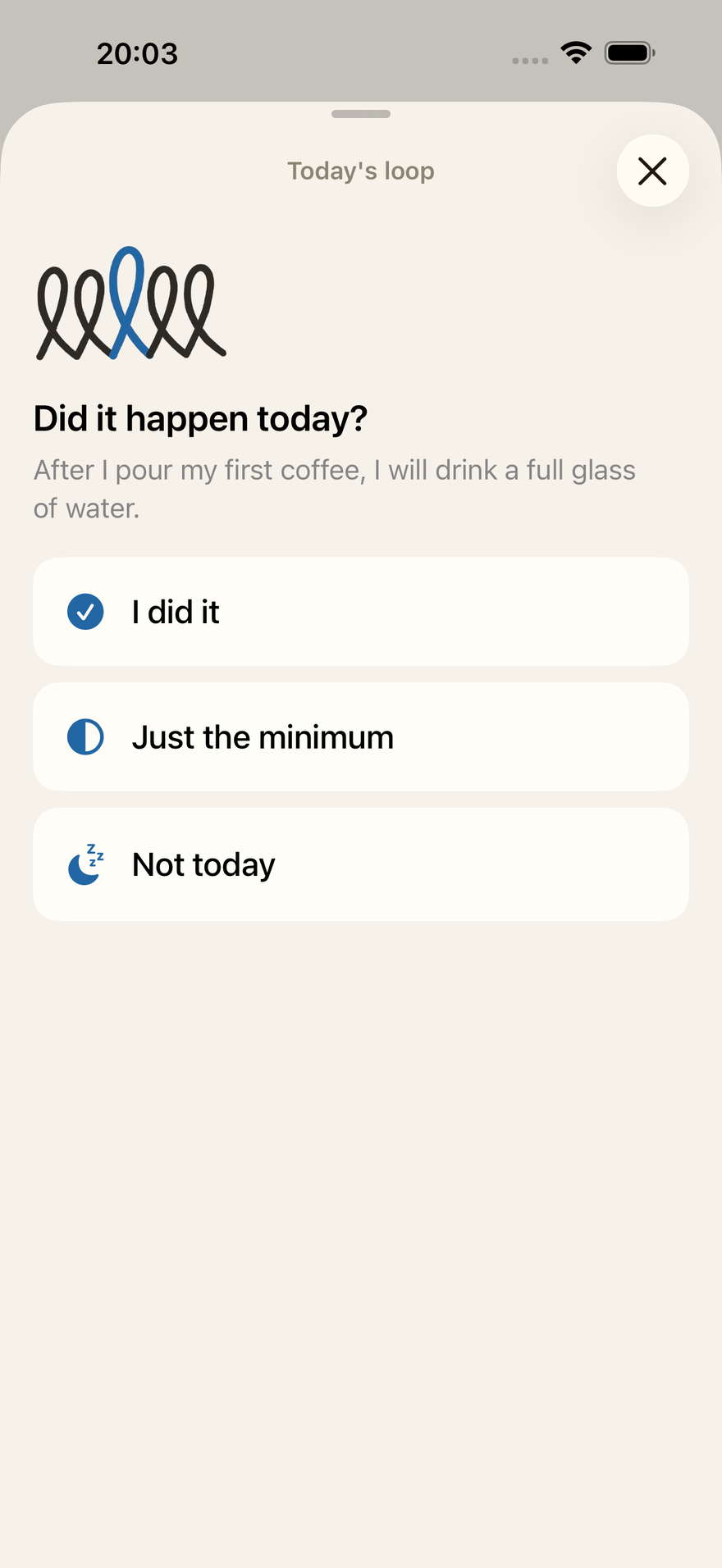
Mini Loops offers water as a ready-made plan, with those three moments and sizes already written. See it on the App Store
On daily totals
The figure most people are aiming at is eight glasses a day. It is worth knowing that this number has no strong basis and is not a recommendation from anywhere in particular. It has simply been repeated for decades, in the same way the twenty-one days figure has.
More to the point for this page, a daily total is a poor thing to build a habit around. You cannot see it without counting, counting is itself a habit you would have to build first, and the number is unfalsifiable enough that missing it produces vague guilt rather than useful information.
How much anyone should drink depends on things this page has no view on and no business having a view on. What is safe to say is that a habit is built by one repetition at one moment, and that is a much smaller thing to aim at.
If it stops happening
- "Forgot" repeatedly. The default failure for this habit. The cue is not distinctive enough or the glass is not there. Move the glass to where the cue happens before changing anything else.
- "The moment never came" repeatedly. You attached it to something that does not happen at weekends, or on days you work elsewhere. Brushing your teeth survives almost every kind of day.
- It happens but nothing feels different. That is not a habit problem, and this is not the page for it.
Adding a second moment
Once the first glass has stopped being a decision — which is a matter of weeks, not days — the cheapest way to drink more is a second cue rather than a bigger first one. Lunch is the obvious candidate, and it is a separate small habit rather than a doubling of this one.
That said, one glass a day held for a year beats four glasses held for a fortnight, and there is no requirement to progress at all.
Common questions
How do I remember to drink water?
Stop trying to remember and attach it to something you already do. One glass when you pour your first coffee, or when you sit down at your desk, or when you brush your teeth. Repeated forgetting is a sign that the cue is missing rather than that your memory is at fault.
Do I really need eight glasses of water a day?
That figure has no strong basis and has simply been repeated for a long time. How much anyone should drink is a question for a doctor rather than for a habit app. For building the habit, one glass attached to a reliable moment is the useful target.
Does tea or coffee count?
For the purposes of building this habit, what matters is that a specific action follows a specific cue. If the habit you want is a glass of water, make the plan say a glass of water, because a plan that accepts anything is not a plan.
Is a big water bottle a good idea?
Yes, and it is worth being clear that it works by changing what is in front of you rather than by building a habit. That is a real and useful effect. It just does not travel with you the way an automatic response does.
How long before drinking water becomes automatic?
Simple behaviours settled faster than effortful ones in the field research, and this is about as simple as a habit gets, so it tends towards the quicker end. The median across all habits in that study was 66 days, with a very wide spread.
What if I drink a lot in one go instead of through the day?
For habit-building purposes that is a different behaviour with a different cue, and it will not make the small regular one automatic. Whether it matters otherwise is a question for a doctor.