How to make exercise a daily habit
Updated 19 August 2026
Short answer
Attach it to changing out of your work clothes, or to getting out of bed, and set the hard-day version at five press-ups or simply putting your trainers on and starting. The ordinary version can be twenty minutes.
Exercise fails as a habit more often than anything else on this list, and almost always for the same reason: the plan is a full session, so a day without room for a full session becomes a day with nothing in it.
- The habit is showing up at the moment. The session is what happens afterwards.
- “Put my trainers on and start” is a real hard-day version, because starting is the part that gets skipped.
- A cue tied to leaving work beats a cue tied to a time.
- Daily and small builds the habit faster than three big sessions a week.
- Rest days are a training decision. The habit still wants a small version on them.
- If you are training for something specific, the programme is not the habit and should not be confused with it.
Why exercise is the hardest one to make daily
Three things make it harder than any other habit here, and none of them is motivation.
The size is enormous by default. Nobody plans to read for two hours, but almost everybody plans to exercise for forty minutes. A forty-minute plan needs a day with a forty-minute hole in it, and most weeks contain two or three such days. That gives you two or three repetitions a week, which is a slow way to build anything.
It has a threshold. Changing clothes, travelling, equipment. The threshold is where the skipping happens, and it is why the most useful hard-day version is often not an exercise at all but the act of crossing the threshold: trainers on, out of the door.
It gets confused with training. Building a habit and following a programme are two different projects. A programme has rest days, progression and a target. A habit wants the same small thing at the same moment every day. You can run both, but only if you stop grading the habit by the programme's standards.
The plan
The moment. Changing out of your work clothes is the best cue most people have: it happens daily, it has a clear edge, and you are already half-way to being changed. Getting home from work is a weaker version of the same thing, and getting out of bed is the strongest cue of all if mornings suit you.
Avoid "after work" as a phrase. It is a period, not an event, and it stretches until it is nine o'clock.
The ordinary version. Twenty minutes, one full session, half an hour. Pick one and leave it alone for a fortnight.
The hard-day version. Five press-ups. One set. Trainers on and out of the door. The point of these is not the training effect, which is negligible, but that the day still contains the thing, at the usual moment, so the association survives the week.
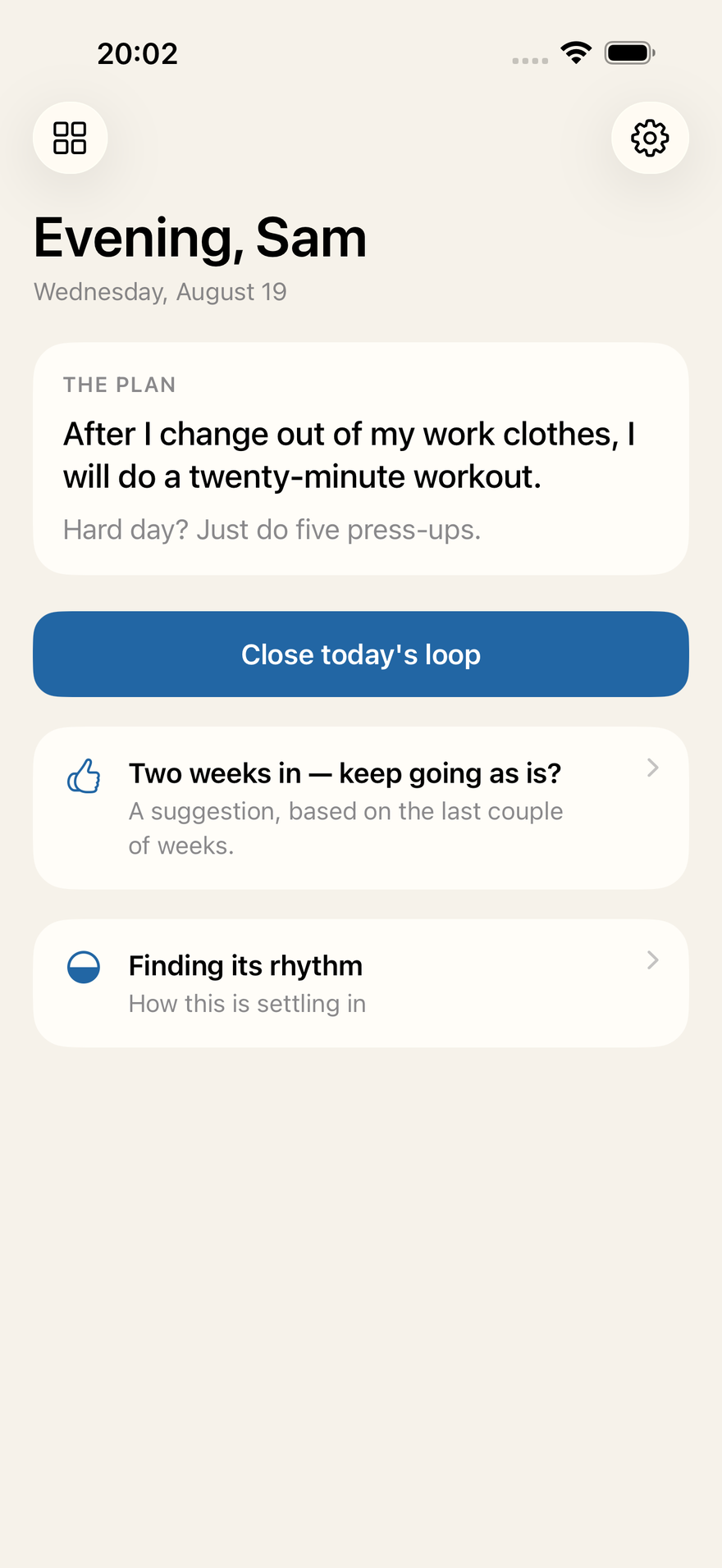
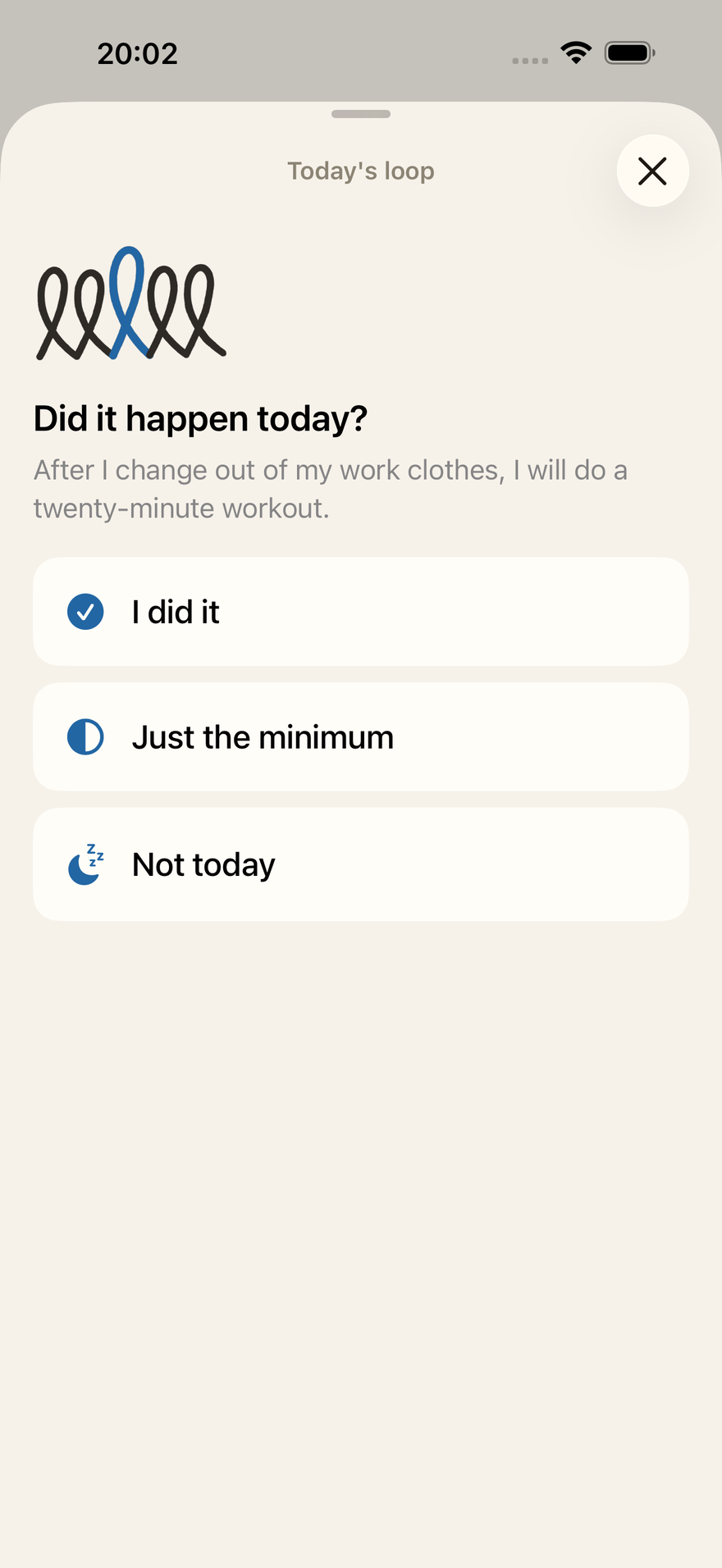
Mini Loops asks for the small version at setup, before the first bad week rather than during it. See it on the App Store
What about rest days
A rest day is a decision about training load. It is not a decision about the habit, and treating it as one is how a week off becomes a month off.
The version that holds both is to keep the moment and drop to the hard-day version: five press-ups, or a walk, or the stretch you have been meaning to do. The cue still fires, the response still follows, and nothing about your recovery is compromised by two minutes.
If it stops happening
- "No time" repeatedly. The ordinary version is too big. Halve it. Twenty minutes becomes ten. This is the answer far more often than people accept.
- "Too tired" repeatedly, in the evening. Move the whole habit to the morning before trying to fix the size. Evening energy is not something you can plan around.
- "The moment never came" repeatedly. Your cue depends on a day that does not always happen. Re-attach it to something that does — getting out of bed survives almost everything.
How Mini Loops handles it
Exercise is in the app's ready-made list with those cues and sizes already written. The daily check-in is two taps, and there is no session log, no total and no streak.
If the same obstacle keeps appearing it names it and proposes one change — a smaller size, a different moment — which you accept or decline. Nothing changes on its own.
Common questions
How do I make exercise a daily habit?
Attach it to an event that happens every day, such as changing out of your work clothes or getting out of bed, and set a hard-day version small enough to do on any day at all — five press-ups, or putting your trainers on and starting. Keep the moment fixed and let the size vary.
Should I exercise every day or have rest days?
Rest days are a training decision and a sensible one. For the habit, keep the moment and drop to the small version on those days, so the cue is still followed by something. A week of doing nothing at the usual moment is how the habit rather than the training gets lost.
Is five press-ups really worth doing?
As training, barely. As a repetition at the moment you planned, it is worth as much as a full session, because repetition in a consistent context is what builds the habit. The full sessions are what happens on the days you have room.
Why do I always stop exercising after two weeks?
Almost always because the plan was a full session and the first week without room for one produced a gap, and the gap had no smaller version to fall back on. A plan with a floor survives that week.
What time of day is best to exercise for building a habit?
The time you can repeat. Morning wins for most people who have tried both, because nothing has gone wrong yet and no meeting can move it. What matters more than the hour is that it is attached to an event rather than to a clock.
Can I build an exercise habit and follow a training programme at once?
Yes, as long as you do not grade one by the other. The programme decides what you do on the days you train; the habit decides that something happens at the same moment every day.