How to meditate every day
Updated 19 August 2026
Short answer
Attach it to sitting down at your desk, or to getting out of bed, and make the ordinary version ten minutes. The hard-day version is three slow breaths.
What makes this habit fail is not the difficulty. It is that people grade the session afterwards and conclude they were bad at it. No other habit on this site invites that, and it is the single most useful thing to stop doing.
- A wandering mind is not a failed session. It is the ordinary content of a session.
- Three breaths is a version nobody can be bad at, which is exactly why it works as a floor.
- A fixed cue beats a fixed length. Ten minutes at a random hour is worth less than one minute at the same one.
- Guided sessions build a habit around an app and a length. That is fine until the app is not there.
- A timer removes the decision about when to stop, which is the second-largest source of friction.
- This page has no view on what meditation does for you. It is about making it repeat.
The failure that belongs to this habit
Every habit here has a characteristic way of dying. For reading it is a page target; for exercise it is the size. For this one it is an assessment.
People finish a session, notice they spent most of it thinking about an email, and conclude they cannot do it. Then the next day's session carries the weight of the last verdict, and within a fortnight the habit is gone — not because it was hard, but because it was being marked.
The plain version is that a mind that wanders is what a session is made of. There is nothing to be good at, and the only question a habit asks is whether the thing happened at the moment it was supposed to. Sitting down at all is the entire behaviour.
This is also why the hard-day version matters more here than almost anywhere else. Three slow breaths is not an inferior session. It is a version of the habit that cannot be failed, and so it cannot be graded.
The plan
The moment. Sitting down at your desk is the strongest cue for most people who work at one: it happens daily, it has a hard edge, and you are already seated. Getting out of bed suits people whose mornings are their own. Getting into bed works, with the caveat that falling asleep is a likely outcome, which is fine but does mean the repetition is shorter than it looks.
The ordinary version. Ten minutes, fifteen minutes, or a short session. Pick one and leave it for a fortnight.
The hard-day version. Ten slow breaths, one minute, or three slow breaths. All three are real answers on a real day.
A timer. Worth using, for one reason that has nothing to do with practice: it removes the decision about when to stop. Without one, every session contains a running negotiation, and negotiations are what habits exist to avoid.
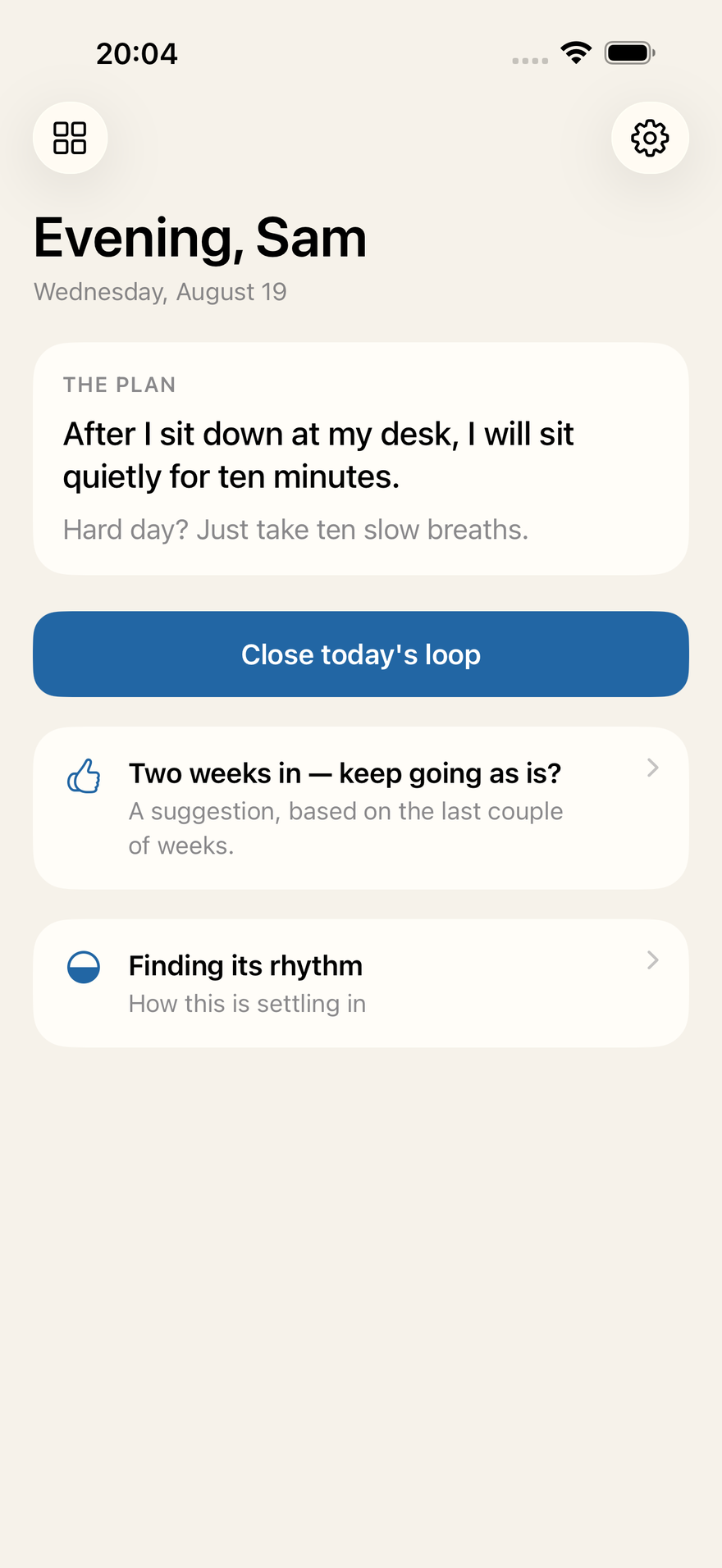
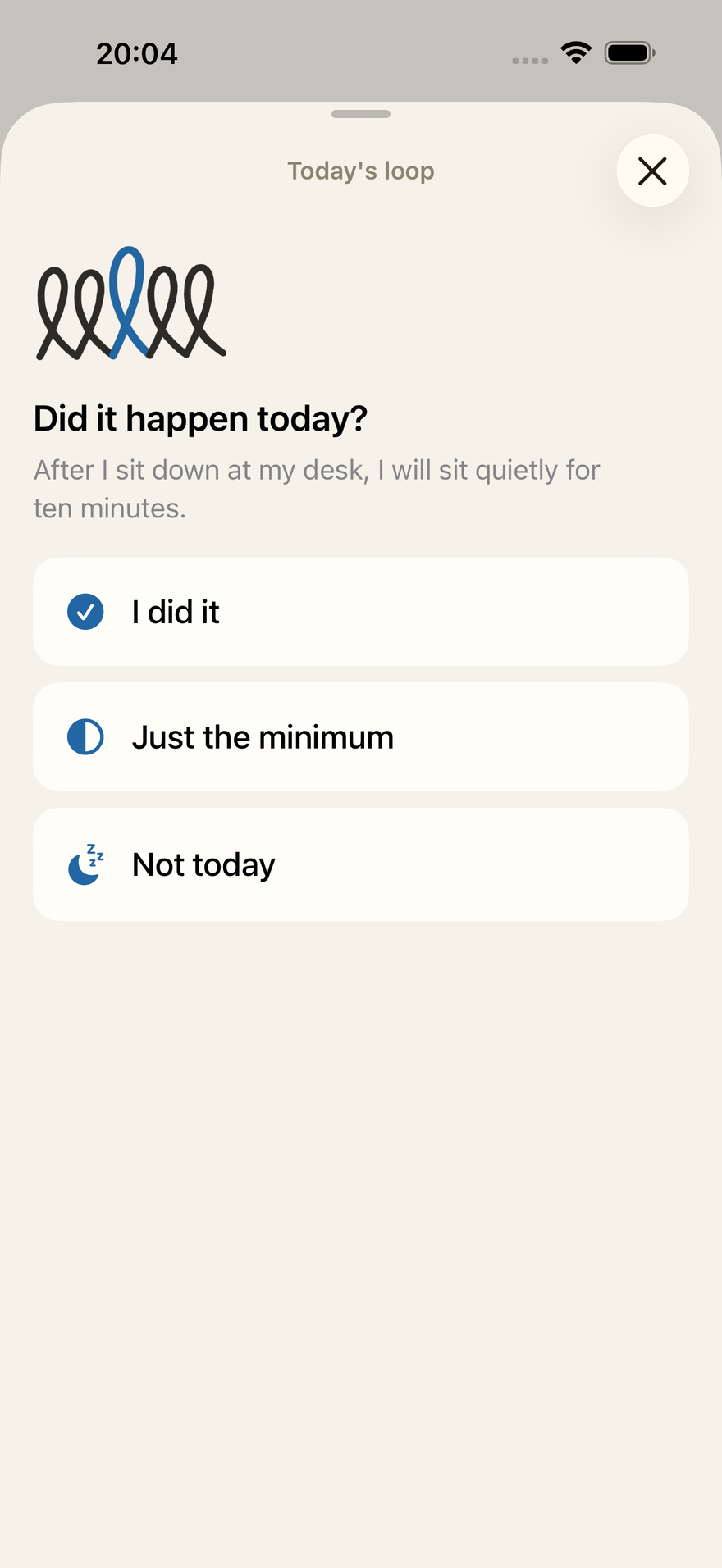
Mini Loops offers this as a ready-made plan, including the three-breath version for the days that fall apart. See it on the App Store
Guided sessions and the app problem
Guided audio makes starting far easier, and for the first weeks that is worth a great deal. It comes with a specific cost that is worth going in aware of: the habit you build is open the app, put in headphones, listen for twelve minutes, and every part of that chain is a dependency.
On a day without headphones, without signal, or without twelve minutes, the whole thing has no smaller version — the same shape of failure as a skincare routine to fall back on, because the smaller version was never yours to define. That is the mechanism by which a hundred-day run inside an app ends in a week away from it.
The fix is not to abandon guided sessions. It is to define your own hard-day version, independent of any app, and to use it often enough that it is real.
If it stops happening
- "Didn't want to" repeatedly. The most common answer here, and it usually means the session is being graded. Drop to the smallest version for a fortnight and stop assessing it.
- "No time" repeatedly. Ten minutes is too big for the moment you chose. One minute at the same moment is worth more than ten at a moment that keeps not arriving.
- "The moment never came" repeatedly. The cue is tied to a day shape that is not reliable. Getting out of bed survives more kinds of day than a desk does.
Common questions
How do I build a daily meditation habit?
Attach it to an event that already happens every day, such as sitting down at your desk, keep the ordinary version around ten minutes, and set a hard-day version of three slow breaths. Use a timer so that when to stop is not a decision.
Is one minute of meditation worth doing?
For building the habit, yes, because repetition at a consistent moment is the mechanism and length is not part of it. One minute daily makes the behaviour automatic faster than twenty minutes twice a week.
My mind wanders constantly. Am I doing it wrong?
A wandering mind is the ordinary content of a session rather than a sign of failure. The habit only asks whether you sat down at the moment you planned to. Grading the session afterwards is the most common reason people stop.
Should I use a guided meditation app?
It makes starting much easier and is worth using early on. Be aware that it builds a habit that depends on the app, the headphones and a particular length, so define your own short version that needs none of those, and use it sometimes.
What time of day is best to meditate?
The time you can repeat. Morning is popular because nothing has gone wrong yet. What matters more than the hour is that it is attached to an event with a clear edge rather than to a time on a clock.
How long until meditating feels automatic?
The field research found a median of 66 days across everyday habits, with a range from 18 to 254. A short version at a very reliable cue tends towards the faster end.